Brace for long winded, technical response!

I approached this from a slightly different angle – keeping in mind that spring selection is a compromise among competing priorities. You need to know the desired ride height, the available suspension travel, the car weight (ideally the corner weights), the relationship between wheelrate and springrate (determined by suspension geometry) and finally the road characteristics you are likely to encounter.
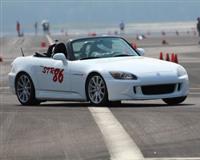
Using my car as an example, we'll start with the front:
Let’s say we’re going to lower the car to the point where we have 4” of suspension travel before hitting the bumpstops. When last on the scales I had LF=844lbs, RF= 848lbs. For simplicity, let’s say 850lbs each. I haven’t weighed the wheels, tires, knuckles, control arms, strut, spring and CV shaft, but I guessing there’s about 150lbs of unsprung weight at each corner - leaving 700lbs of sprung. Let’s assume we are going to be driving on a fairly smooth track so we design for a maximum 1.5g bump. Based on these assumptions, we would be absorbing a 1050lb force over 4”, therefore requiring a minimum wheelrate of 262.5lb/in.
Of course wheel rate and spring rate are not the same, but they a related by a constant that is a function of the control arm linkage ratios and the instant center of the front suspension.
Time for some formulae:
WR=C*SR
or
WR=(MR)^2*SR*ACR
where
WR = Wheel rate
MR = Motion Ratio
SR = Spring rate
ACF = Angle correction factor or sin(θ); θ = the angle between the LCA and the strut
Strictly speaking: MR=SQRT[(a/b)^2 * (c/d)^2]
where
a = LCA inner pivot point to the point where the spring attaches to the LCA
b = Length of the LCA from the inner pivot point to the ball joint
c = LCA ball joint to the instant center
d = Center of the tire contact patch to the instant center
The instant center is the intersection of two imaginary lines: one formed by the angle of the UCA and the other formed by the angle of the LCA. This is where you can have some variability. Also, the instant center changes with ride height.
On many cars you can simplify: MR=a/b and the answers should be very similar. The dominant term is a/b. Being off a couple of degrees and even a couple of inches in the c/d measurements makes little difference, but a 1/4" error in the a/b measurements makes a big difference.
On the front of my car I found
a=9.25"
b=12.625"
c=163"
d=167"
θ = 75deg. (remember this changes with ride height also)
After some number crunching, I came up with:
MR=0.715
WR=0.5SR. (the spring compresses 0.5" for every 1" of wheel travel)
Therefore we, need a 525lb/in spring to handle a 1.5g bump in 4 inches.
Suspension travel has a dramatic impact on spring rate. In this example, if you lower the car another inch you would need 700lb/in springs – which is in fact what I did.
Suspension geometry also has a dramatic impact. If we use an eccentric bushing at the lower strut mount that could move the strut mount outward 0.5”, it would change our SR formula to WR=0.6SR. Now we could lower the car to 3” of travel and use 575lb/in springs.
Here I'm setup to measure the rear. I like to attach strings to all the suspension pivot points, then tie a weight to the end. Makes measuring a bit easier.

Thru the same analysis, I ended up with 500lb springs in the rear (and 700lb in the front). I think it has worked out pretty well. YMMV
Cash

 Login
Login Register
 FAQ
FAQ Search