Aaron Buckley wrote:
The key to meeting the CAFE limits is reducing overall car weight, which in turn, reduces safety to some extent, but increases overall car performance.
I did a small amount of reading about CAFE today and the above is apparently one of the common arguments against CAFE. I can see the logic, but to a degree you can only reduce the weight so much before you run into issues with crash tests. Granted, you could reduce safety and still pass the crash tests and that is not an ideal thing.
But I sort of wonder if the strategy of reducing weight is just old school thinking. In that it works, but there may be other solutions today. I assume that the entire idea is to increase the economy of acceleration. The less weight, the less energy to get up to speed. Many scratch their heads when looking at hybrids as they give better around town mileage (due to electric stop and go), but when cruising at highway speeds, they are not going to do much if any better than a similar car with a similar gas only engine. The point being that they are only on electric at lower speeds. So I wonder if more hybrid technology can help bump up the overall average MPH as reported via CAFE testing standards?
Aaron Buckley wrote:
Exactly, how is the EPA testing vehicles?
NHTSA has a CAFE page
http://www.nhtsa.dot.gov/ (Click on the "Vehicles and Equipment" tab on the top and then the "CAFE" topic on the left)
If you look at the FAQ they talk about testing.
CAFE FAQ wrote:
EPA is responsible for calculating the average fuel economy for each manufacturer. CAFE certification is done either one of two ways: 1) The manufacturer provides its own fuel economy test data, or 2) the EPA will obtain a vehicle and test it in its Office of Transportation & Air Quality facility in Ann Arbor, MI. EPA will do actual tests on typically about 30% of the existing vehicle lines, using the same laboratory test that they use to measure exhaust emissions. The entire certification test procedure, including the vehicle test preparation, the actual running of the test on the dynamometer, the recording of the data, etc., is specified in Title 40 of the Code of Federal Regulations.
GM doesn't have to meet the CAFE standards if they don't want to. They would just pay a per car penalty. I assume that if demand is high enough, that GM could price their RWD products in a way that they include the penalty.
CAFE FAQ wrote:
Since 1983, manufacturers have paid more than $675 million in CAFE civil penalties. Most European manufacturers regularly pay CAFE civil penalties ranging from less than $1 million to more than $20 million annually. Asian and most of the big domestic manufacturers have never paid a civil penalty.
It's also interesting to know that the entire "domestic" vs. "foreign" fleet stuff was put into the original law due to the UAW not wanting someone like GM to pull a "Geo" and just stop making cars here in the US (Actually domestic is counted as US, Canada and now Mexico as part of NAFTA) and sell cars built outside of the US.
_________________
Richard Casto
1972 Porsche 914
2013 Honda Fit Sport
2015 Honda Fit EX
http://motorsport.zyyz.comMoney can't buy happiness, but somehow it's more comfortable to cry in a Porsche than a Kia.

 Login
Login Register
 FAQ
FAQ Search



 not so good.

 The problem in this case is that it's so far out of the powerband, that the car struggles to keep speed. It would be like your Corvette had a 10spd gear box and you were doing 20 mph in 10th
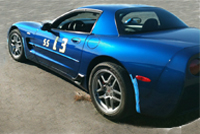
 It is pretty sad when people sit around a racetrack comparing gas mileage