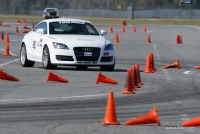
All great comments above. The two day Extreme School was a great experience yet again, and I'll be glad to take it again next year, but the Challenge School sounds very interesting.
The looking ahead skill is filled with SO many variables that unless you continually practice it, it is very easy to get rusty/lazy. By variables I'm referring to the creation, at each event, in your plan, of where are the key points to be looking ahead to at any given point on course in addition to "how" you look ahead (i.e. general target point with scanning, moving that target point continually and properly, etc). Having Tim Aro be voraciously "hungry" for each new element was inspiring.
In any event, proper eye/vision technique is perhaps the single most important skill in an autocross once you are performing at a high level since you only have four or so runs to "master" a given course, and then it will all be different next time -- totally unlike a track where you can drive it hundreds of times and mentally rehearse it thousands of times, and it will be substantially identical the next time you're there.
I had two main goals for the Extreme school in addition to many minor goals. One was to be able to bring back what I have learned to use in every autox event from now on. I hope to accomplish that by having "Virtual Tim" riding shotgun with me. Tim Aro and I did many runs where on the first lap all he did was call vision points and how he would look at the course, and on the second lap he would go silent. It was great training since on that second lap I could still hear his voice in my head helping me through the course. My goal now is to continue creating these vision points like I always have, but now have VirtualTim running the show once on course. Mental tricks like these we can use on ourselves are sometimes profoundly helpful. I've used something similar for 27 years ever since my good friend Ray Korman gave me some outstanding instruction at Mid-Ohio -- part of Ray has been with me since.

My second main goal was to be able to use Tim as a mentor from an instructor standpoint so that I can better help those I instruct in the future. The hardest part about instructing is translating that feeling and imagery you have in your mind to your student -- communicating that synesthesia in a mode that a student can grasp is profoundly difficult to do well.
I worked the course when Mike Miller, Stephen, Mo and Bernie were running, and I have to say that watching all of them progress rapidly and REALLY smoke that course was a highlight of the school.

When one of them would finish a clean run, with no overdriving the sweepers, no cones down and having blasted through the slalom and offsets right on the cones, it sure was a great thing to watch. I can't wait to see them use what they have learned in future events!

 Login
Login Register
 FAQ
FAQ Search