Enthusiasts have taken a quick shine to the Tesla Roadster--but the nifty two-seater is not truly a harbinger of things to come from the California electric carmaker.
Tesla’s goal is to make more mainstream cars, though it admits that’s far from reality. The company’s future product plans include two more models that could build volume and expand it beyond its current status as a producer of niche sports cars.
The Model S, an eye-catching sedan, is due in about two and a half years. A third car, which would perhaps be the most affordable, could arrive about five years.
“The roadster is really a stepping stone,” Tesla CEO Elon Musk said at the Detroit auto show. He compared the Roadster to early Porches and hopes it will become a collector’s item.
Musk said the Roadster could sell 700-1,000 units a year, while the Model S could reach 20,000 annually if things go well. The Model S will also be available through leasing.
“The strategy has always been to get to mass-market electric cars,” Musk said.
The company did click off a milestone recently, producing its 1,000 car, which it displayed at the Detroit auto show. It will be auctioned for charity, including three in the Detroit area.
Musk touched on a range of subjects during his media briefing. He also said:
-- Daimler, which has a stake in Tesla, has been a “benign and benevolent partner,” offering access to its supply chain and other support.
--A team of 18 Tesla employees made the trip to Detroit for the show in a white Roadster Sport. The car, which was a bit dirty after the trip, was also at the company’s display and traced the route through Phoenix, San Antonio, Chicago and other stops en route to Detroit.
--There are currently two running prototypes of the Model S, but the company hopes to have 20 or 30 by the end of the year.
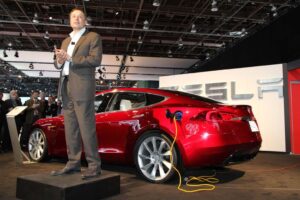
Tesla doesn't need to go public to fund the next two models it plans to introduce, said founder Elon Musk, standing in front of a prototype Model S battery car
The electric car revolution is firmly underway, said Tesla Motors founder Elon Musk, as he rolled out a prototype of the Silicon Valley start-up’s second battery car, the Model S, at the 2010 North American International Auto Show.
Once derided as something of a crackpot, Musk has become more of a roll model to an auto industry that has rapidly come to embrace the concept of electrification. But the challenge for Musk and the Tesla team is to move from niche to mainstream. Near the Model S prototype, the automaker also displayed the 1000th Roadster to roll off its assembly line. While Musk described it as a “milestone,” he admitted a typical auto assembly plant will produce that many vehicles in a day.
Going forward, Tesla expects to produce between 700 and 1,000 of the 2-seaters annually. But the goal is to boost production of the 7-seat Model S sedan to 20,000, said Musk, when it reaches market sometime in 2012.
“And we want to do perhaps 200,000 units of production with our more affordable car,” a reference to a still secret vehicle program that Musk hopes to bring to market around 2014. While the Roadster currently costs more than $100,000, Tesla plans to lease the Model S for roughly the same monthly payment as a conventional, $35,000 gasoline-powered vehicle.
Driving the price tag even lower on the “affordable” third Tesla model would depend on a variety of factors, but nothing more importantly than driving down the price of batteries – the single highest cost with today’s electric vehicles. Currently, a kilowatt-hour of lithium ion batteries goes for more than $1,000, but Musk suggested “We could get to mass market (economics) at $300 a kilowatt-hour.”
A recently study by the Boston Consulting Group suggests that target may be a bit optimistic, however, cautioning that the industry might not be able to do much better than $400 a kWh by 2020.
“Consultants,” countered Musk, during a press preview at the Detroit Auto Show, “are not always good augers of the future.”
The battery-electric vehicle (BEV) maker showed a brief, quarterly profit, in mid-2009, but Musk warned that it won’t likely repeat that feat anytime soon, not while it is using the sales proceeds from a low-volume product to fund the development of a high-volume vehicle, cautioned the Tesla founder, who earned a fortune going public with an earlier project, Paypal.
Musk said he “aspires…to go public” with a Tesla IPO, though he insisted the company could fund the development of its next two models without an Initial Public Offering — thanks in part to money it expects to get from a federal loan and cash raised through a partnership with Germany’s Daimler AG. In fact, he suggested to a crowd of reporters pressing him for company details, “A lot of things get harder in a public company, like answering questions.”

 Login
Login Register
 FAQ
FAQ Search